
Worldly Knowledge and Clever Discernment Are Useless
But you already knew that.

Not knowing what to do: A student said to Xuansha, “I’ve just entered the monastery. Please, master, tell me what to do.” Xuansha said, “Do you hear the sound of the mountain stream in the gorge?” “I hear it,” the student said. “You should enter there,” Xuansha said.
Here we are on questions eight, nine, and ten of Fenyang’s Eighteen Questions, which I’ve been translating over the past year. To learn about the previous seven questions, please read my past posts here, here and here.
Xuansha Shibei 玄沙師備 (835-908) was a well known figure in Tang Dynasty Zen. Originally from Fuzhou, on the southern Chinese coast, he supposedly came from a family of fishermen who made their living in the many rivers and lakes in that part of the country. According to the traditional sources (here quoted in Andy Ferguson’s Zen’s Chinese Heritage): “He carried on an ascetic practice, wearing only a patched robe and straw sandals. He often fasted instead of taking the evening meal, and was regarded as unusual by the other monks. He was called ‘Ascetic Bei.’” He was one of several dharma heirs of Xuefeng Yicun; his transmission line eventually became known as the Fayan school, while another heir of Xuefeng, Yunmen Wenyan, created the Yunmen school. Those are two of the Five Houses of Zen explored in Eyes of Humans, Eyes of Gods. If the Linji school is best known for shouts and hits, the Fayan and Yunmen schools are known for subtle, incisive teachings that involve a lot of wordplay and verbal acrobatics. (We will see more of this below in Yunmen’s response in question ten.)
This koan, which is also recorded in Zen’s Chinese Heritage, points to Chinese Zen’s intimate embrace of the natural world. The most famous example of this is Su Shi’s (Su Dongpo’s) poem:
The voices of the river valley are the [Buddha's] wide and long tongue,
The form of the mountains is nothing other than his pure body.
Through the night, eighty-four thousand verses.
On another day, how can I tell them to others?
Perhaps Xuansha’s love of the sound of water has something to do with his background in the rivers and lakes of Fujian province—who knows? It’s a reminder for us to stay grounded in simply observing the world around us, whether that’s the sound of babbling brook or waterfall, or the horns and sirens of Manhattan, where I spend most of my time.
On to the next question:
To carry a burden: A student said to a senior monk, “I know that worldly knowledge and clever discernment are useless, but I still have to solve my huatou.” The monk hit him.
This one is challenging to translate. My version of what the student says differs sharply from the Cleary version, which reads, “Worldly knowledge and brilliant intellect should not be brought out at all’— return the words to me.” The problem is the second phrase or sentence, 還我話頭來, literally “return/(to) me/word/head/come.” 話頭 “word head” or huatou, as we know, is a key Zen term meaning the key word or phrase in a koan. So the student isn’t simply saying “return the words to me,” as Cleary’s literal translation puts it; he’s saying “return my huatou to me.” Well, what does that mean? In my mind the student is doing one of two things:
Quoting the first phrase, “Worldly knowledge and clever discernment are useless,” and then saying, “Where is the huatou in this?” In other words, “What’s the point, how should I practice with this challenge?”
Using the first phrase to make a point about his own koan practice: he knows that his intelligence and analytical abilities aren’t helpful, but he’s not sure how else to approach the huatou.
I choose the second option in my translation. Of course, either way, the monk would likely give him the same response: thwap! You already know this; why are you wasting my time saying it? That’s a quick way to relieve a student of their burden.
To lay out what’s in front of you: Yunmen was asked, “What does it mean when you stare at something but don’t see its edges?” Yunmen replied, “A mirror.”
Yunmen’s koans are always fun to translate, because in 21st century English his short and cryptic responses sound like deadpan humor. Whether he meant them to be funny is a question largely lost to time—it’s always helpful to remember that these texts have been around for over a thousand years, and so much of the nuance is lost or highly debatable.
The question Yunmen is asked is a little perplexing. Literally, it’s “When you stare but don’t see the edges [boundaries], then what?” I added “at something” because it seems clear that the questioner means staring at some object or visual field that appears boundaryless, but I suppose you could stare in an unfocused way and that would also be boundaryless. Yunmen’s reply, 鑒 jian, means both “mirror” and “reflection” or “reflect” as a verb. So you could also translate it as, “Your own reflection.” It’s tempting to interpret this as a statement about narcissism (as in the actual myth of Narcissus, who fell in love with his own reflection in a pool). But it’s important not to impose Western theories of mind on premodern Chinese texts. My best guess is that the questioner is talking about some kind of vision or heightened visual experience, perhaps the result of what they think is an enlightenment experience. And Yunmen quickly says: Yourself! You’re just looking at yourself! In other words, mind creates everything—your incredible vision is just a mental phenomenon, as empty as any other phenomenon.
Speaking of cryptic one-word statements: Fenyang for some reason uses one-word descriptions for the types of questions after number ten, so here we’re stuck with 置 zhi, which means “to place, to set out, to lay out,” but can also mean “to buy” or “to abandon.” There’s a lot of guesswork involved in teasing out his intended meanings for this last part of the list. As always, please comment below if you think I’m headed the wrong way.
不會 問玄沙。學人乍入叢林。乞師指 示。沙云。汝聞偃溪水聲麼。僧云聞。沙 云。從這裏入。
擎擔 問老宿。世智辨聰。總不要拈出。 還我話頭來。宿便打。
置 問雲門。瞪目不見邊際時如何。門云鑒。
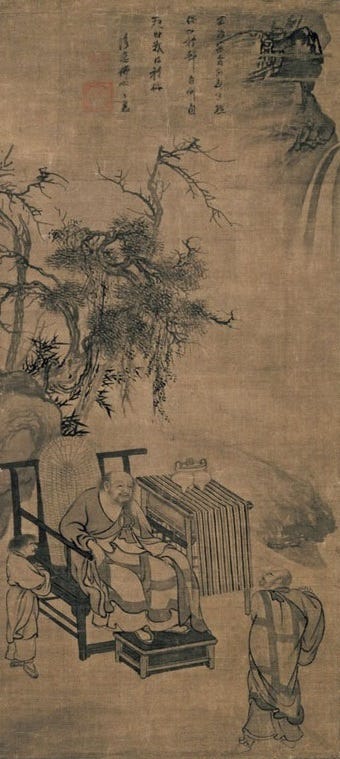
Image credit: “Xuefeng Receives his Student Xuansha” 雪峰接玄沙生圖
Attributed to Muxi Fachang 牧谿法常 (13th century) Late 13th century, Yuan (1271-1368) Encomium by Yuji Zhihui 愚極智慧 (act. 1298) Hanging scroll, ink on silk, 102 x 46 cm Kyoto National Museum, AK672 Important Cultural Property
Great job. 🙏🏽 I own Andy’s text and read from it regularly. Historical work is very important. Thank you for your efforts 🙏🏽🙏🏽🙏🏽