
Fenyang's 六七
Nowhere on the Internet is safe from juvenile meme discourse, not even the Great Way of the Ancients.

If you’ve been anywhere near a tween or teenager in the last few months, you’ve doubtless heard the nonsense phrase “Six-Seven.” (Or in Chinese, 六七.) Even if you’re safely in a world of adults and insulated from teen-speak—which is where all the most interesting and dynamic developments in language happen—you may have seen the articles bemoaning the Six-Seven trend as further evidence that online brainrot is killing our childrens’ minds. The worst part, according to the experts, is that Six-Seven doesn’t mean anything.
Of course, in the Zen tradition, we’ve been preparing for Six-Seven for more than a thousand years. We were born ready. Without flinching, we could drop Six-Seven into any number of classic koans, like:
Zhaozhou visited a hermit and asked, “Do you have it? Do you have it?” The hermit looked up and said “Six-Seven.”
“The water is too shallow to anchor here,” Zhaozhou said, and went away.
He went to another hermit and called out, “Do you have it? Do you have it?” The hermit looked up and said “Six-Seven.”
“You are free to give or take away, to kill or to give life,” said Zhaozhou, bowing to him.
The koan tradition overflows with seemingly meaningless or random gestures like this, all in the service of dislodging our minds from the casual, lazy habits of dualistic, referential thinking. Try it this way:
Zhaozhou visited a hermit and asked, “What do you think of Khloe Kardashian’s most recent plastic surgery?” The hermit looked up and said “Six-Seven.”
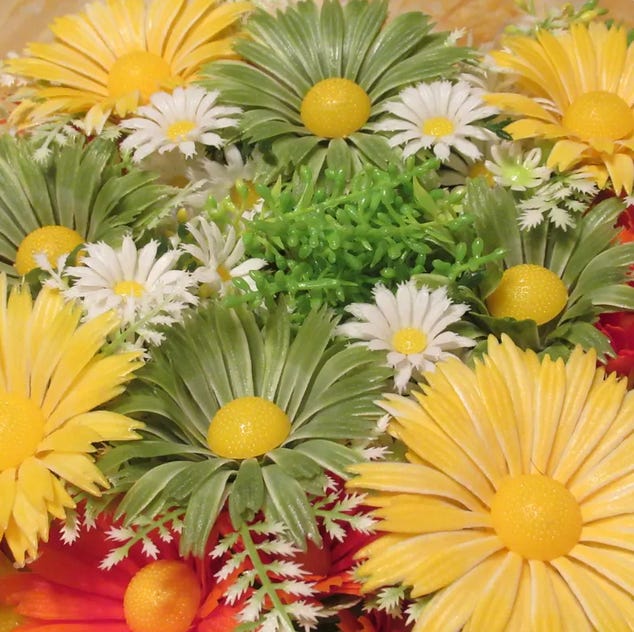
Six-Seven, Khloe Kardashian, Brazilian butt lifts, K-pop Demon Hunters—all part of the ten thousand dharmas that, like it or not, make up our world. Zen Master Seung Sahn, the founder of my school, used to lecture his Western students about their fixation on 1970s-style natural living; there’s a well-known story in our tradition about how a visitor once brought garish artificial flowers to the Zen Center and a student didn’t want to put them on the altar:
As soon as he could, the student hid the flowers under a pile of coats. But soon, another woman found them and, with the greatest delight, walked into the Dharma Room and put them in a vase on the altar. The student was very upset. He went to Seung Sahn and said, “Those plastic flowers are awful. Can’t I take them off the altar and dump them somewhere?’
Seung Sahn said, “It is your mind that is plastic. The whole universe is plastic.’‘
The student said, “What do you mean?’‘
Seung Sahn said, “Buddha said, ‘When one mind is pure, the whole universe is pure; when one mind is tainted, the whole universe is tainted.’ …If you desire something, then you are attached to it. If you reject it, you are just as attached to it. Being attached to a thing means that it becomes a hindrance in your mind. So ‘I don’t like plastic’ is the same as ‘I like plastic’—both are attachments. You don’t like plastic flowers, so your mind has become plastic, and the whole universe is plastic. Put it all down. Then you won’t be hindered by anything. You won’t care whether the flowers are plastic or real, whether they are on the altar or in the garbage pail. This is true freedom.”
Anyway! Speaking of true freedom, our reason for being here today is Fenyang’s sixth and seventh questions in his list of Eighteen Questions, a way of categorizing koans by the intention of the person asking the initial question. You can read my previous two posts on the Eighteen Questions here and here. The five types of questions Fenyang has proposed so far are:
To ask for instruction: The questioner asks a simple question, like “What is Buddha?”
To present (or ask for) an explanation: The questioner wants to know what a certain saying or symbol means.
To observe and make distinctions: The questioner makes some observation and asks for more details or for clarification.
To take advantage of a situation: The questioner needs reassurance due to some kind of distress.
To be off balance: The questioner wants to challenge the teacher with an attack-style question.
The sixth question is:
6. To demonstrate mental activity/chaos: A student said to Xinghua, “I can’t distinguish black from white. Please teach me.” Hua made a sound and struck the student.
Xinghua Cunjiang 興化存奬 (830-888) was a student of Linji who lived and taught in Weizhou in the far north of China—what is today Shandong Province. Koans and sayings associated with him turn up in many Tang dynasty collections. The category of question Fenyang proposes here is 心行 xinxing, “mind / movement,” although 行 can also mean “practice” (as in “to practice Zen”) or any number of similar verbs related to activity or doing something. I think of Fenyang’s meaning as something like the student saying “I can’t stop my mind from moving, I feel like I’ve lost my bearings completely, I can’t find a still point, I’ve lost all my focus.” In other words, the “mental activity” or mind movement is indecision, overthinking, over-excitement.
And just as his teacher would have done, Xinghua cuts through the student’s mental problems in the bluntest way possible: an utterance and a blow. Interestingly, though, the text doesn’t describe what Xinghua did as a Linji-style shout (that would be 喝, he) but simply as a sound or, more obscurely, a statement (聲 sheng). As I’ve discussed in earlier posts, the Linji tradition is very specific about the meaning of the shout in different circumstances, so we can take for granted that this is a specific indication that whatever sound Xinghua made, it was not a shout. If it was a statement or announcement, what was it? Cleary translates the line as “Hua hit him as he spoke,” but that seems frustratingly vague. Perhaps the meaning is something like “Hua announced his intention by hitting the student,” but to me that doesn’t make much sense. So I have no choice but to be vague as well: Xinghua made some kind of sound, and hit the student. The hit seems to carry the real weight here.
On to question seven:
7. To inquire in a reasonable way: Fengxue was asked, “Why is that a person who has not attained [enlightenment] has no doubts?” Xue responded: “When the sacred tortoise crawls through the mud, how can it not leave tracks?”
Fengxue Yanzhao 風穴延沼 (896-973) is a third generation Linji master who shows up repeatedly in Eyes of Humans, Eyes of Gods, and also appears in cases 38 and 61 of the Blue Cliff Record. According to Linji school transmission records, he was Fenyang’s grand-teacher—that is, Fengxue gave transmission to Shoushan Xingnian, and Shoushan gave transmission to Fenyang—and it’s even possible that Fenyang met Fengxue, since he was in his thirties when Fengxue died.
If question six falls into the broad category of “questions from people who need urgent help with their practice,” question seven falls into another broad category, “questions any reasonable person would wonder about.” I’m sure every serious practitioner has had the experience of encountering people who know very little about Buddhism yet speak about it with great confidence. I put the word “enlightenment” in brackets here because the Chinese verb “attain” could refer to many things; I’m assuming from context that the questioner is asking about people who haven’t made any spiritual progress, but it’s not explicitly stated.
Fengxue’s response invites us to puzzle through an analogy, which is maybe fitting, given the theoretical nature of the question. (A sharper response would obviously be, “Stop worrying about other peoples’ non-attainment and worry instead about your non-attainment!”) A person who’s not gifted enough to actually see the sacred tortoise can still see the tortoise’s tracks in the mud—is that it? Or maybe Fengxue is referring to the sacred tortoise’s longevity, which is its most important characteristic in Chinese mythology. According to at least one account, a tortoise that attains the name sacred tortoise is at least 10,000 years old. Zen students and teachers, by nature of our dogged and earth-bound practice, have to cultivate the third paramita, known as kshanti in Sanskrit or 忍辱 renru in Chinese—that is, the perfection of patience. If we are any type of spiritual being, we’re not the fluttery type with long streaming sleeves who adorn the top of every altar painting. We’re down in the mud, stirring up more mud as we make our slow but steady way. We have to be patient with everyone, even overconfident idiots. (And also with ourselves when we turn out to be the overconfident idiots.)
心行 問興化。學人皂白未分。乞師方便。 化隨聲便打。
探拔 問風穴。不會底人。為甚麼不疑。 穴云。靈龜行陸地。爭免曳泥蹤。