
Fenyang Has Some Questions For You
Too many to fit in one post.

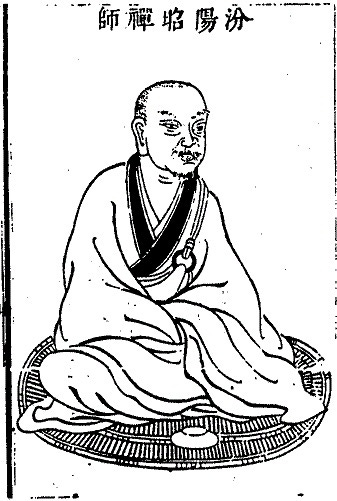
In the 11th and 12th centuries Fenyang Shanzhao—giving us some side-eye in the unflattering portrait above—was one of the best-known Zen masters of the Linji school. He hasn’t received nearly as much attention from contemporary students of the tradition. His collected sayings or yulu haven’t been translated into English; he didn’t edit a well-known anthology or create a canonical text like the Oxherding Pictures; he wasn’t famous as a secular poet. Nonetheless, he’s a major presence in Eyes of Humans, Eyes of Gods, and clearly was much in the minds of Zen students in Zhizhao’s time. There are several grouped teachings attributed to him in the Linji section of this text, but the one that stands out is “Fenyang’s Eighteen Questions,” an attempt to classify different types of koans in use in the Linji school at the time. (Zen students who were patient enough to get to the end of the Thomas and J.C. Cleary translation of the Blue Cliff Record may remember that it includes a translation of the Eighteen Questions in their section on “Traditional Teaching Devices”; I consulted that translation and will try to improve on it.)
Readers of my previous posts will know that Eyes of Humans, Eyes of Gods is not overly concerned with koans. Instead, Zhizhao, the editor, focuses on various teaching devices and frameworks (the Four Shouts, for example) that were popular at the time. There’s no mention in the text of kanhua chan 看話禪, the “Zen of studying the words,” the koan-study method made popular by Zhizhao’s older (and much more famous) contemporary Dahui Zonggao, which has influenced all koan-oriented Zen practice up to the present day. Although Zhizhao quotes Dahui extensively, he doesn’t focus on Dahui’s interest in koans.
That said, this passage from Fenyang is a valuable window into an approach to koans that wasn’t widely taken up by other Zen teachers or editors of the era. As Guo Gu Laoshi (Jimmy Yu) explains in an excellent chapter of his new anthology Readings of the Gateless Barrier, Song-era teachers and editors either tended to promote wide reading in the koan literature (available in the gigantic, encyclopedic collections like the various Transmission of the Lamp or String of Pearls anthologies, some of which contained as many as 11,000 distinct koans) or highly selective reading of a few representative koans with commentaries (for example, the Blue Cliff Record, published around 1125, the Gateless Barrier or Wumenguan, published around 1228, and the Congrong Lu or Book of Serenity, published in 1224). But Fenyang is interested in something different: he wants to identify eighteen distinct varieties, or purposes, of teacher-student interactions. In other words, as he says in introducing the Eighteen Questions, you have to “see where the question is coming from” (須識來意):
Fenyang said, “The general idea is this: it can be difficult to distinguish between the question that’s being asked out loud and the silent question behind it (the subtext). You have to be able to see where the question is coming from. Every time a question is asked, there’s some particular reason for it. You have to respect the deep meaning of the words that are spoken, and not apply fantastic or obscure interpretations to them. There’s no point in doing that. Even if you do it with a good intention, it will produce a bad result. We must be cautious and careful in our analysis.”
The Eighteen Questions are way too much material to cover in one post; you could write a whole book about them. To kick things off, here I’m going to limit myself to the first three.
1. To ask for instruction: A monk asked Mazu, “What is Buddha?” Mazu said, “This very mind is Buddha.” Zhaozhou commented, “Look in the temple.”
The question to Mazu and Mazu’s response is a very famous koan that appears in the Wumenguan and Transmission of the Lamp, and it seems obvious why this would be called “To ask for instruction,” as it’s a question even a child or beginner would ask.
What about Zhaozhou’s comment, “Look in the temple”? Here I have Brook Ziporyn to thank, because my original translation was inaccurate. 殿裏底 literally translates as “Temple / inside / bottom, base, end, arrival point, origin,” but Brook points out that 底 can also be used as a possessive(的 or 之)meaning the literal meaning is, “It’s in the temple.” In other words: “What is Buddha? Buddha’s in the temple, up on the altar!”
Zhaozhou’s response, by the way, doesn’t appear in the Wumenguan, but it does appear in the Transmission of the Lamp as a direct response to the same question:
A monk asked [Zhaozhou]: “What is Buddha?” Zhaozhou said: “Look in the temple.”
You have to wonder: is this answer indirectly referring to Mazu’s famous answer, or is it supposed to stand on its own? Tell me what you think in the comments.
2. To present an explanation: Longya was asked, “What is the meaning of the saying, ‘The sky cannot cover it, the ground cannot hold it up?’” Longya said, “Followers of the Way should be like this.”
This koan is not nearly as familiar, and its background is a little puzzling. Longya Judun 龍牙居遁 (835-923) was a dharma heir of Dongshan Liangjie in the Tang dynasty and a contemporary of Linji; he’s most famous for asking Linji “What is the meaning of Bodhidharma coming from the West?” in case 20 of the Blue Cliff Record. However, the saying Longya is asked about is only (as far as I can tell) attributed to Mingjue 明覺 (also known as Xuedou Chongxian 雪竇重顯), 980-1052, a fourth-generation Zen master in the Yunmen school, who was not born until 50 years after Longya died. There are three obvious explanations:
1) The saying wasn’t original to Mingjue (highly likely)
2) There was another Zen master named Longya (possible but less likely)
3) Whoever made up the koan didn’t care about the chronological problem (maybe the most likely)
Nonetheless, if we ignore chronology for a moment, we can appreciate the terrific passage this koan might refer to, found in Mingjue’s/Xuedou’s Collected Sayings:
有時拈起拄杖云。天不能蓋地不能載。復以拄杖畫一畫云。百千諸佛諸代祖師。盡向翠 峯乞命。
On one occasion, [Mingjue] picked up his walking stick and said, ‘The sky cannot cover it, the ground cannot hold it up.” He then wrote a single line [the Chinese character for 1, 一] on the ground with his stick and said, “A hundred thousand Buddhas and patriarchs face Jade Peak and beg for their lives.”
Brook Ziporyn came to the rescue here again to help me clarify the second sentence (see comments below). Of course, for a Zen master, “presenting an explanation” doesn’t involve interpreting or directly addressing words or concepts. Longya’s explanation speaks for itself, whether or not you know the relevant passage in Mingjue.
3. To observe and make distinctions: Linji was asked this: “A student has a question: what is it like when you stand in the teacher’s place?” Linji responded, “Say it quickly! Say it quickly!” The monk hesitated, considering. Linji hit him.
This one knocked my socks off, because it’s pretty unusual to come across a saying of Linji’s that isn’t preserved either in the Linji Lu or in one of the major anthologies. Nonetheless, this one belongs to Eyes of Humans, Eyes of Gods alone. (Whether it was passed down through the oral tradition, or taken from an earlier version of the Linji Lu that no longer exists, or made up by a third party, is anyone’s guess.)
The Cleary translation is of the first part is: "The student has a question; how is it when it is on the part of the teacher?" I’m not sure what “how is it when it is on the part of the teacher” is supposed to mean; the Chinese is 在和尚處時如何, “at or in / teacher’s / place or position / time (at that time) / how is it?” To me it seems clear that the student is asking (in a way that is very, very unusual in the Zen tradition) “what is it like to be a teacher?” Linji’s response is characteristically direct: 速道速道, “quick or fast / speak / quick or fast / speak.” That could be interpreted at least two ways: “Tell me what’s it’s like!” Or, “You’re the teacher, say something!” This is host-and-guest style dharma combat, at a lightning fast pace.
What does “To observe and make distinctions” mean? I would say it has to do with the student’s attitude: “Teacher, what is it like to be you?” Which obviously is creating the distinction between teacher and student. Then Linji cuts through the distinction immediately: “Say it quickly!”
There’s so much great material in Fenyang’s Eighteen Questions that I could spend the next year deciphering it. Rather than do that, in subsequent posts I will probably keep moving into the Yunmen School section of Eyes of Humans, Eyes of Gods, and come back to the Eighteen Questions when the time feels right.
As always, thanks for reading, and please share and subscribe.
汾陽十八問
汾陽云。大意除實問默問難辨。須識來意。 餘者總有時節。言說淺深相度祗應。不得妄 生穿鑿。彼此無利益。雖是善因。而招惡果。
切須子細。
請益 僧問馬祖。如何是佛。祖云。即心是 佛。趙州云。殿裏底。
呈解 問龍牙。天不能蓋。地不能載時如 何。牙云。道者合如是。
察辨 問臨濟。學人有一問。在和尚處時如何。濟云。速道速道。僧擬議。濟便打。
Jess, Looking at #2: "To present an explanation," DDB has "question where the trainee offers their understanding of the matter" - and Fenyang here is classifying the questions, not so much the responses. However, your comment above is about Longya's response, if I'm reading you correctly. I'm thinking that Fenyang sees the practitioner's question as the presentation of their understanding, in this case that understanding is: “What is the meaning of the saying, ‘The sky cannot cover it, the ground cannot hold it up?’” Longya then affirms that understanding. So that's my presentation of an explanation. What do you see?
Jess, More great material here. Thanks! Historically, a curious detail there with Longya and Xuedou. I just had a similar quirk with Xinghua who died in 888 having a dialogue with an Emperor whose reign started in 953. Hmmm. The old Zennists were brilliant, but the histories often don't align with what we think of today as "true." I look forward to more of these.