
Three is the Magic Number
Who really came up with Yunmen's Three Phrases?

Yunmen addressed the assembly: “Containing Heaven and Earth, distinguishing things at a glance, not traversing this world of causes and conditions—how can we undertake these things?"
The assembly did not respond.
He then said, “One arrow passes three barriers.”
Afterward, Zen Master Deshan Yuanming illuminated three crucial phrases in Yunmen’s words:
1) Covering (or containing) the universe
2) Cutting off the streams
3) Drifting along with the waves
With this post we enter the second section of Eyes of Humans, Eyes of Gods: the school or house of Yunmen. Like all the subsequent sections (on the schools of Caodong, Guiyang, and Fayan) this one is much shorter than the first section on the Linji school—which makes perfect sense, not only because Zhizhao, the editor, was a Linji monk, but because by 1188 the Linji school was becoming so dominant that the idea of Five Houses of Zen was mostly a historical construct. The Yunmen school, in particular, was in the process of being absorbed into Linji, so it makes sense that it would appear second in the anthology.
As we’ve seen throughout the Linji section, Eyes of Humans, Eyes of Gods is primarily organized around numerical sets of teachings, which tells us something about how popular and useful these teaching devices were in the large Zen monasteries of the Song dynasty (and among the lay audience for Zen teachings, which was also enormous). By the time Eyes of Humans, Eyes of Gods appeared, Yunmen’s Three Phrases were widely known; they appear in cases in both the Blue Cliff Record—Case 27 (Yunmen’s “Body Exposed in the Golden Wind”)—and the Book of Serenity Case 76 (Shoushan’s “Three Phrases.”)
In his commentary to BCR Case 27, Yuanwu says (this is the Cleary translation):
You must understand how Yunmen raises one and illuminates three, raises three and illuminates one. If you go to his three phrases to seek, then you're pulling an arrow out of the back of your head. In a single phrase of Yunmen's, three phrases are inevitably present: the phrase that contains heaven and earth, the phrase that follows the waves and pursues the currents, and the phrase that cuts off the myriad streams. (What he says) is naturally exactly appropriate. But tell me, of the three phrases, which one does Yunmen use to receive people? Try to discern this.
There’s much to be said about this idea—three phrases expressed in one, the one phrase that “passes three barriers”—but first it’s important to understand the origin of Yunmen’s Three Phrases, which are really an interpretation of something Yunmen said by one of his disciples.* What we have here is a pretty rare opportunity to see a numerical teaching being created in real time, so to speak.
To begin with, what did Yunmen actually say? There are several ways to read the Chinese text, which like many classical Chinese texts isn’t clearly punctuated (in the original it may not have been punctuated at all). There are five distinct verbal phrases:
1) 函蓋乾坤 Heaven and Earth are covered (contained, obscured, encompassed).
2) 目機銖兩 [You can] tell [them] apart/distinguish [something?] at a glance.
3) 不涉萬緣 Not traversing/don’t traverse this world of causes and conditions.
4) 作麼生承當 How can [you] bear it?
5) 一鏃破三關 One arrow passes three barriers.
Out of these five phrases, Deshan derived the Three Phrases, which are:
1) 函蓋乾坤 Covering (or containing) Heaven and Earth
2) 截斷眾流 Cutting off the streams
3) 隨波逐浪 Drifting along with the waves
On first glance, it would seem that two of Deshan’s Three Phrases are easy to spot in Yunmen’s speech. 1 is 1 (the same words), and Deshan’s 2 appears to be similar to Yunmen’s 3. That leaves three of Yunmen’s phrases unexplained: 2, 4, and 5.
The most suggestive thing Yunmen says, of course, is phrase 5: “One arrow passes three barriers.” This indicates that whatever he just said comprises three significant statements, even if there are four phrases. It took me a few drafts and some valuable advice to tease out Yunmen’s meaning, which I render this way:
Containing Heaven and Earth, distinguishing things at a glance, not traversing this world of causes and conditions—how can we undertake these things?
But there’s a real problem here. Deshan’s phrase “Drifting along with the waves” doesn’t seem to correspond to anything Yunmen said. Viewed in the simplest way, it would seem Deshan got two phrases from Yunmen and added one of his own.
Let’s pause for a second and examine the text from a different light. The act of openly interpreting, or re-phrasing, or revising, something a master said is uncommon in the Chinese Zen tradition, at least in the way Deshan is doing it here. The sentence that describes Deshan’s action reads like this:
後來德山圓明密禪師。遂離其語為三句。
Afterward / Zen Master Deshan Yuanming (Mi) / then / separated, clarified, interpreted, illuminated / these / words / as, into / three phrases
Afterward, Zen Master Deshan Yuanming illuminated three crucial phrases in Yunmen’s words.
The tricky element here is the verb li 離, which is one of those words in classical Chinese that can have many different meanings depending on context. Most often it means “separate” or “to separate,” but because we’re talking about a mental act involving ideas, it can also mean “to distinguish,” “to clarify,” “to identify,” “to interpret.” In this case particularly, the ambiguity of 離 means we have to make a call about what Deshan is doing. Is he separating Yunmen’s words; is he clarifying them; is he deriving something from them? Is the gist of what Yunmen says the important thing, or the (unstated) implication of it, or the literal words? Those are all different interpretive (or creative) acts.
I brought this question of the correct meaning of 離 to my translator friends Dosho Port, Brook Ziporyn, and Hang Ruan, and Hang Ruan pointed out something about this text that can easily be overlooked: the phrase “Containing Heaven and Earth” doesn’t literally include the words “Heaven and Earth” (that is, 天 tian and 地 di). Instead Yunmen uses the characters 乾坤 qiankun. 乾 qian and 坤 kun refer to the first and last trigrams of the bagua or Eight Trigrams, which are the basis for the Yijing (I Ching). 乾 is ☰ (three unbroken lines) and 坤 is ☷ (three broken lines). They are commonly associated with Heaven and Earth and Yang and Yin, but they literally just mean ☰ and ☷. And li 離, the crucial verb in question here, is also one of the bagua: it’s the third one, ☲ (unbroken, broken, unbroken), which is described as “flame, radiance, fire, glow.”
So what does it mean to apply ☲ to ☰ and ☷? I know very little about Chinese divination, but I suspect that’s not the point. We’re not talking about literally applying the principles of the Yijing in a Zen Buddhist context; we’re talking about a kind of sophisticated and meaningful wordplay, using references that would have been intimately familiar to any educated Chinese person at the time. If you bring the meaning(s) of ☲ to what Yunmen has said, you’re bringing fire, light, luminescence. You’re also adding a third element to two previous elements, creating a new group of three. Arguably, Deshan’s three verbs, “containing,” “cutting off,” and “drifting along,” can themselves be aligned with ☲, ☰, and ☷:
Containing: ☷, receptive, inner, inward, passive
Cutting off: ☰, aggressive, external, assertive
Drifting along: ☲, illuminating, productive, building, process-oriented
In my view, Yunmen’s second phrase, 目機銖兩, “Distinguishing things at a glance,” is no longer present in Deshan’s formulation—at least not directly. Brook Ziporyn, in our email chain, suggested a different interpretation:
"Cutting off the streams" seems to me more like "not involved in karma" and "distinguishing minutely" seems more like "drifting along with the waves" (i.e., following exactly every changing condition). Could it be Deshan's intervention to arrange the themes as two extremes followed by a middle, regarding the last one as encompassing the two previous extremes in a single whoosh (a single arrow penetrating all three barriers)?
I like this a lot, but I don’t quite follow the connection between Yunmen’s phrase and Deshan’s phrase the way Brook does. To me Deshan’s phrase is an intentional revision and replacement of Yunmen’s phrase, possibly to follow the symbolic values associated with qiankun. Which means that, in my view, these definitely aren’t Yunmen’s Three Phrases—they’re Deshan Yuanming’s Three Phrases.
Brook is absolutely correct, though, that the three phrases in their final arrangement (that is, Deshan’s arrangement) follow a progression of stages of spiritual development. This point is made clear in the commentary to Book of Serenity Case 76, which traces a development of the three phrases or three principles starting not with Yunmen but with Baizhang. (Again, this is the Cleary translation.)
The formulation of the three phrases began with Baizhang Huaihai, based on the Diamond-Cutter Wisdom Scripture: He said, "The words of the teachings all have three successive phases—the beginning, middle, and final good. At first one should just be taught to produce a good mind; in the middle, the good mind is dissolved; only the final good is really good. Thus 'A bodhisattva is not a bodhisattva; this is called a bodhisattva,' and 'The Dharma is not Dharma, nor is it not Dharma.' It's all like this.
…Yunmen once said, "Enclosing the universe in the heavens, judging grains and ounces at a glance, not involved in the conditions of spring—how do you attain to this?" He answered himself, "One arrow smashes three barriers." Even though the idea was there, he never set it up as 'three phrases.' Later he had a successor known as Great Master Yuanming, whose initiatory name was Yuanmi, and who was the ninth generation abbot of Deshan in Yan province; this master said, "One phrase encloses the universe in the heavens, one phrase cuts off all streams, one phrase drifts along with the waves.”
Later he had a successor, Chan Master Dao of Puanshan in Yan province, who made verses on the above three phases:
1. Verse on containing the universe: The universe and myriad forms, Hells and heavens; In everything reality is seen—It is used everywhere without harm.
2. Verse on cutting off all streams: Piling in mountains, heaping in crags, Each is completely dust; If you still try to discuss mystery and marvel, The ice melts and tiles crumble.
3. Verse on following the waves: An eloquent mouth and clever tongue question: High and low, responding without fail, Is like medicine appropriate to the disease; Examination and diagnosis depend on the time.
…If someone asks about it, in Nanyue and Tiantai time and again they say these verses were made by Yunmen—none of them have read carefully. Yuanmi succeeded to Yunmen; though Yunmen had the saying about 'containing the skies' and 'one arrow smashes three barriers,' it was Yuanmi who brought them out, and Dao who put them in verse. After three generations of ancestral tradition, the three phrases were first clarified.
Eyes of Humans, Eyes of Gods also contains the Puanshan Dao poem (labeled “Commentary by Puan Dao”), which indicates that the Book of Serenity (perhaps) used it as a reference. It also contains two other texts on the Three Phrases—far more material than I have time to go into here. What’s fascinating about this whole process is that it gives us a picture of how Chinese Zen evolved from the Tang to the Song dynasty (and beyond) through a process of revision, adaptation, re-formulation—not a static tradition but one where each participant added and amended something of their own. As we still do today.
師示眾云。函蓋乾坤。目機銖兩。不涉萬緣。作麼生承當。眾無對。自代云。一鏃破三關。
後來德山圓明密禪師。遂離其語為三句。曰
1) 函蓋乾坤句。
2) 截斷眾流句。
3) 隨波逐浪句
*Readers familiar with the Deshan of the Blue Cliff Record should know this is a different person—that was Deshan Xuanjian 德山宣鑒, who was Yunmen’s teacher, and this is Deshan Yuanming 德山圓明, aka Yuanmi, who was Yunmen’s disciple. During their lifetimes they were known as “Xuanjian” and “Yuanming”; the confusion arises because posthumously they were given the same honorific name related to Deshan, Virtue Mountain.
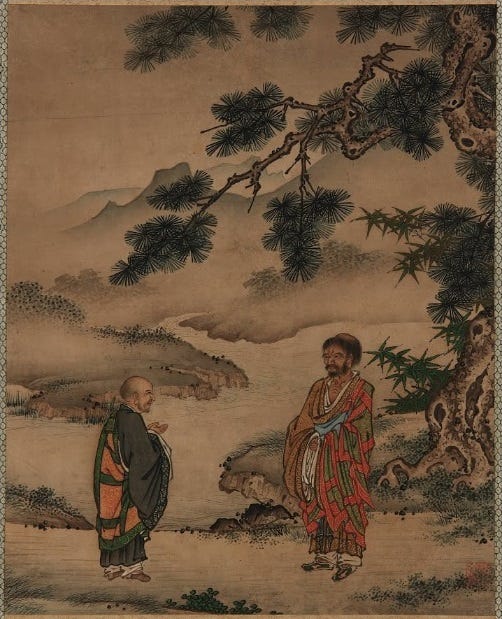
Image credit: Encounter of Yunmen Wenyan and Fayan Wenyi by 賢江祥啓 Kenkō Shōkei (1473-1523) Freer and Sackler Galleries, Washington DC